
From Paris: Inside LexImpact’s Digital Toolbox for Lawmakers
Inside the French National Assembly’s Experiment in Open, Data-Driven Lawmaking

On a recent trip to Paris, I learned about LexImpact, a small, multidisciplinary development team working inside the French National Assembly’s scrutiny and evaluation department. Although the team was created after the 2008 constitutional revision that formalized Parliament’s role in monitoring government action and evaluating public policy, it was not actually established until much later. The tax simulator project began in 2019, and the team officially became part of the National Assembly in 2020. Since then, LexImpact has turned complex datasets and legislative texts into practical tools that members of parliament (MPs) can use in real time. Built on open-source models such as OpenFisca, their tools are transparent and reproducible, while benefiting from contributions by economists, developers, and public administrations outside parliament.
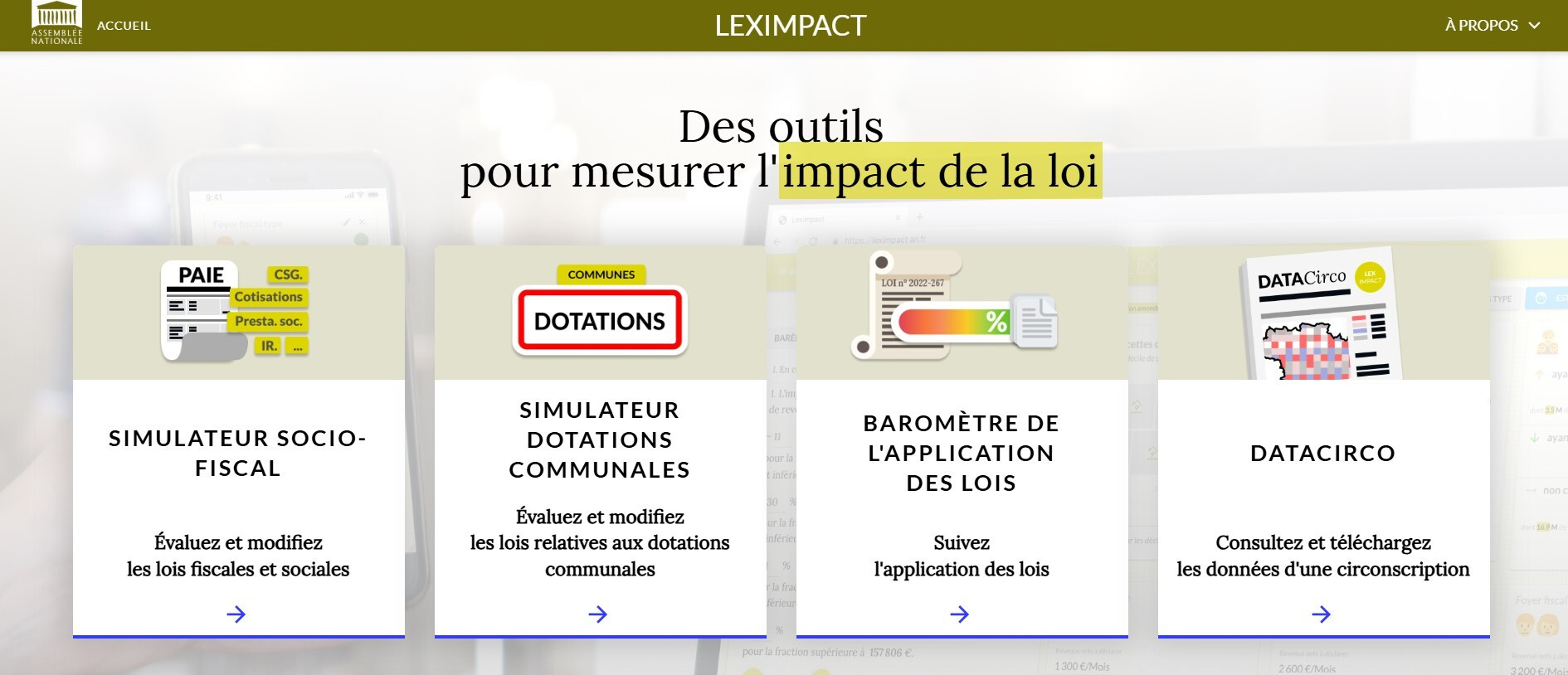
Their four flagship tools address different stages of the lawmaking and oversight process:
1. Tax and Benefits Simulator
First launched as a tax-only calculator and later expanded to include social benefits, this tool addresses a recurring problem: MPs often need quick, reliable fiscal evaluations of proposed amendments, but government responses can take weeks, which doesn't fit the fast-moving budget debates.
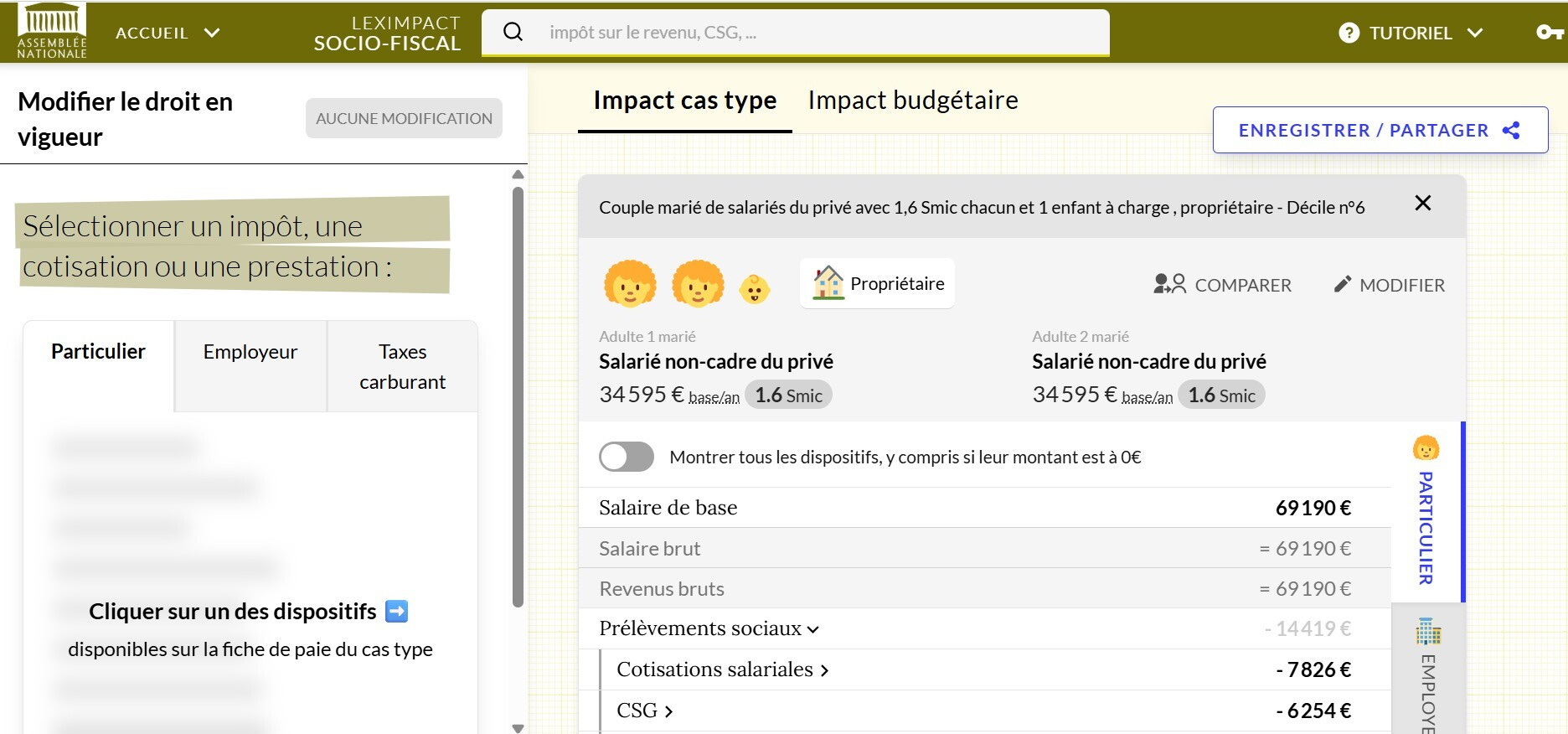
Built on the open-source OpenFisca microsimulation model, the simulator lets MPs – and the public – test how a change to tax or benefit parameters would affect different household types and the national budget. It calculates effects across interconnected rules, revealing unexpected ripple effects (e.g., raising a social contribution rate might lower someone’s income tax).
Users can compare the status quo, government proposals, and their own amendments, with results shown for fictional “test households” and for the whole population. Inside parliament, MPs have access to more detailed budgetary impact data; outside users can request it via email, subject to data protection checks.
2. Municipal Funding Simulator
This tool adapts the same OpenFisca principles to municipal finance. MPs and others can edit parameters in legislation affecting local governments and immediately see the fiscal impact across all 36,000 French municipalities.

By making municipal-level consequences visible, the Municipal Funding Simulator helps legislators understand how national decisions play out locally, which is critical in a country where administrative boundaries (departments, municipalities) often don’t align neatly with parliamentary constituencies.
3. Law Implementation Barometer
This online dashboard tracks the implementation of every enacted law since 2002, excluding certain international agreements. For each law, it lists all the provisions that require a decree before they can take effect, showing whether the decree has been published, how long it took, and – where explicitly stated – who is responsible for issuing it. Because this information is often implicit or contextual in official sources, the Barometer makes it available only when it can be clearly identified, to avoid confusion.
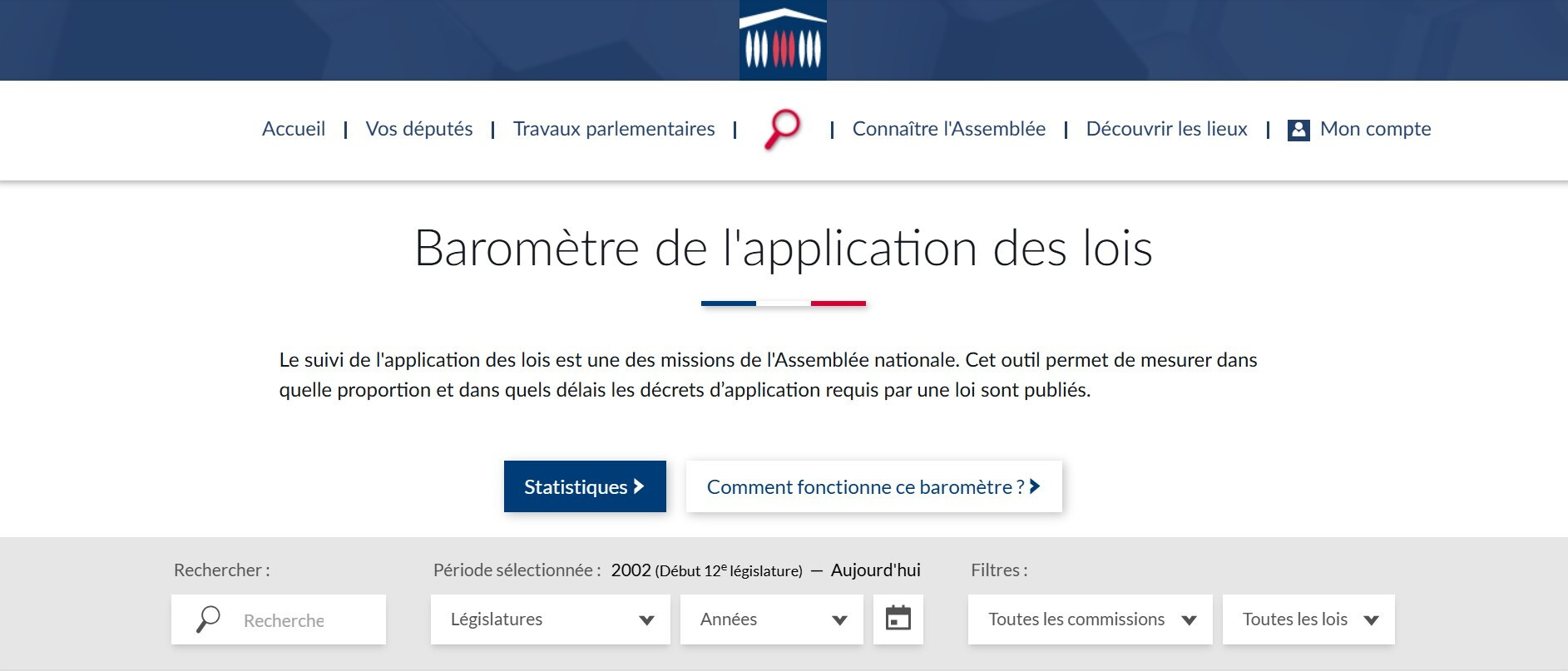
The Barometer merges open data from the government with parliamentary data, calculates enforcement rates, and allows filtering by year, legislative term, policy area, or parliamentary committee. MPs can subscribe to notifications when a decree related to a law they follow is published – saving them from manually checking government tables.
It’s important to note that the Barometer measures only the publication of implementing texts, not whether the administration is applying the law in practice. Still, it delivers a “last mile” service: turning technical, dispersed open data into something MPs (and the public) can quickly understand and use.
4. Datacirco
French government datasets are usually organized by administrative divisions, not parliamentary constituencies, which makes it hard for MPs to get a clear picture of their own districts. Datacirco reprocesses this open data on topics such as education, environment, and health so it aligns with constituency boundaries.
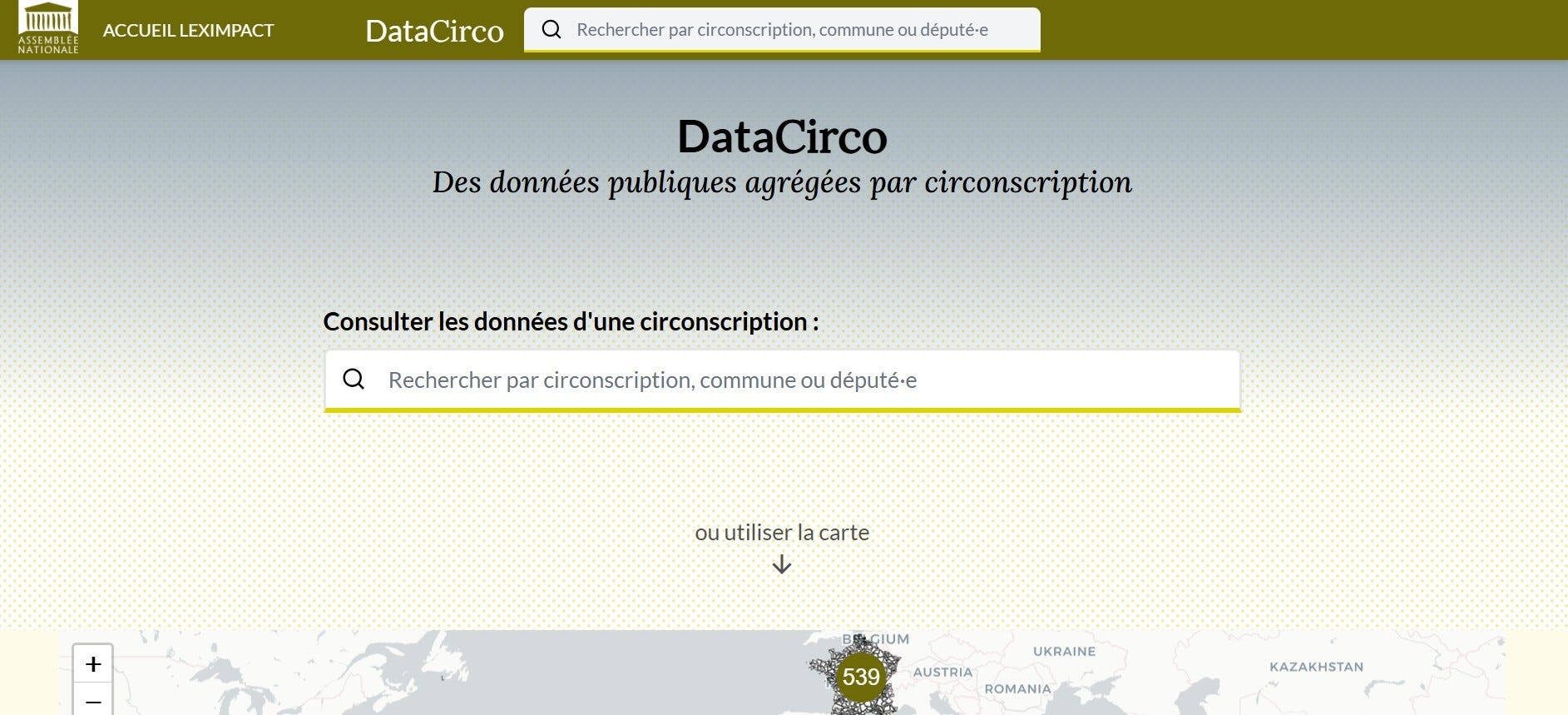
MPs can pull up indicators for their district, compare them to national averages, and drill down into subcategories (e.g., number and type of schools, hospital capacity). Originally a PDF download for use on the go, Datacirco is now an interactive online tool, with every data point linked back to its source.
AI: Where It Fits (and Where It Doesn’t)
None of LexImpact’s tools currently run on AI for their core functions. The team insists on reproducible, transparent calculation – essential for parliamentary work – while AI outputs can vary. However, they are experimenting with AI to assist behind the scenes, such as detecting when laws change and flagging parameters that may need updating. Legal texts’ complexity means human verification remains necessary, especially when numbers in different contexts could be confused.
Why It Matters
LexImpact shows how a small, mixed team – data scientists, economists, developers, legal modelers, and designers – can, with open-source tools and agile methods, create high-value products for legislators. They automate what can be automated, free up time for deeper analysis, and keep their work open to the public whenever possible.
Their approach has lessons far beyond France, especially for parliaments facing capacity gaps. As we’ve seen in other contexts, AI may one day help close those gaps, but the foundation is good data, clear interfaces, and tools designed with legislators’ real constraints in mind.
 | A guest post by
|
Very instersting.